
For treasurers, chairs and committee members. Funding details checked in November 2026.
Most grassroots clubs run on a mix of money: subs and match fees, a sponsor or two, the odd grant, and whatever the summer tournament raises. When one of those dries up, the club feels it straight away.
This guide covers where the money comes from, the UK funds worth knowing, how to write a bid that gets read, and how to keep the money coming in.
Start with what you control: subs and fees
Subs and match fees are the steady base of almost every club’s income, and they’re the part you control. A few things make them work harder:
- Set fees for the season, and publish them early, so families can plan.
- Make paying easy. Card payments online come in sooner than cash in an envelope at training.
- Know who has paid. A treasurer who can see who owes what only needs to chase the few who haven’t paid, not everyone.
- Have a quiet way to help families who are struggling. A hardship policy keeps players who would otherwise drop out.
Get the basics in place before you apply
Most funders ask for some or all of these, so sort them out first:
- A governing document, usually your constitution.
- A committee. Sport England’s Movement Fund, for example, asks for at least three committee members who aren’t related and don’t live together.
- A bank account in the club’s name.
- A safeguarding policy, if you work with children or adults at risk.
- Simple accounts: what came in, what went out and what’s in the bank.
The grants worth knowing
Funds open and close, and their rules change, so check each one’s own page before you plan around it. These were open when we checked in November 2026.
- Sport England Movement Fund. Grants or crowdfunding pledges from £300 to £15,000 for not-for-profit organisations, sports clubs included, that help people get active. There’s no deadline, but apply at least 12 weeks before you want to start; decisions usually take six to eight weeks.
- National Lottery Awards for All England. Grants from £300 to £20,000 for projects of up to two years that bring people together and improve communities. A decision takes about 16 weeks.
- Football Foundation. Grants for football facilities, such as goalposts, storage containers, portable floodlights, pitch improvements and changing rooms. Some grants pause when demand is high, so check the grant’s own page first.
- Your local council and community foundation. Many run small grants for local groups. Search your council’s website for “community grants”.
- Your sport’s governing body. County FAs and other governing bodies often know about local funding, and some run their own schemes.
Sport England covers England only. In Wales, Scotland and Northern Ireland, look at Sport Wales, sportscotland and Sport NI, and at the National Lottery Community Fund’s programmes for each nation.
Writing a bid that gets read
Funders read a lot of bids. The ones that succeed are specific.
- Start with the need, in numbers you can show. Not “we need more equipment”, but “our under-12 girls’ squad has grown from 8 players to 19 and shares six balls”.
- Say what will change, and for whom. Who will play more, or play for the first time, because of this grant?
- Match the funder’s priorities, in their words. Read the guidance and answer the questions they ask, not the ones you’d like to answer.
- Show a real budget, with quotes for equipment, hire costs per hour and any other money you’re putting in.
- Say how you’ll know it worked: the number playing, the sessions run, the players who stay from one season to the next.
- Ask someone outside the committee to read it before you send it.
A bid checklist
- We’re eligible: the right kind of organisation, in the right area, under the funder’s limit.
- Our constitution, committee details and bank account are ready.
- Our safeguarding policy is attached, if the project involves children.
- The need is explained with numbers.
- We’ve said what will change, and for whom.
- The budget has quotes.
- Other sources of money are named.
- We’ve said how we’ll measure it.
- We’ve applied in good time before the money is needed.
- A second person has read it.
A worked example
Say a club’s new girls’ section needs £3,000 for its first season: £1,500 for portable goals and a storage container, £1,200 for winter pitch hire and £300 for coaching courses. Rather than pin everything on one big bid, the committee splits it:
- £1,800 from a grant, from a fund whose priorities include getting more girls active, for the pitch hire and coaching courses.
- £600 from a sponsor. A local business pays for its logo on the section’s shirts and a thank-you on the club’s website.
- £480 from an appeal to parents, grandparents and former players.
- £120 in Gift Aid. The club is a CASC and most of the appeal’s donors are UK taxpayers who signed a Gift Aid declaration, so the club claims another 25p for every £1 they gave.
If the grant falls through, the section still has two-fifths of what it needs, and a clear story for the next bid.
Gift Aid and CASC status
If your club is a registered charity or a community amateur sports club (CASC), Gift Aid adds 25p to every £1 a UK taxpayer gives, as long as they’ve made a Gift Aid declaration.
- Gift Aid is for donations. You can’t claim it on membership subs, or on payments for something people get in return.
- CASC status brings more than Gift Aid. A registered CASC can apply for business rates relief of up to 80%, and gets some tax reliefs on its income. HMRC sets the conditions, so check them before you apply.
- Small cash gifts count too. Once you’re claiming Gift Aid, the Gift Aid Small Donations Scheme lets you claim 25% on cash and contactless donations of £30 or less without a declaration, up to £2,000 a year. Think bucket collections at the summer tournament.
Sponsors: make it easy to say yes
- Start close to home: businesses run by parents, players and former players, and the shops and trades near your ground.
- Offer something specific: a shirt sponsorship, a pitch-side board, a named tournament, a season of training kit.
- Put it on one page: what they get, what it costs and how long it lasts.
- Agree it in writing, even briefly, so both sides know what’s promised.
- Thank them in public, and send a short report at the end of the season, with photos you have consent to share. That’s when you ask them to renew.
Spread the risk
- Don’t let one sponsor or one grant pay for most of your running costs. If it stops, the club shouldn’t stop with it.
- Keep a reserve. Even a few months of pitch hire in the bank gives the committee time to react.
- Review it once a year, at the AGM: what came in, from where, and what’s due to end.
How YourZown helps
- Subs, match fees and one-off payment requests, paid by card straight into your club’s own Stripe account.
- The treasurer sees who has paid and who hasn’t, and can mark money that came in another way as paid.
- Reminders go out before payment deadlines, so nobody has to chase by hand.
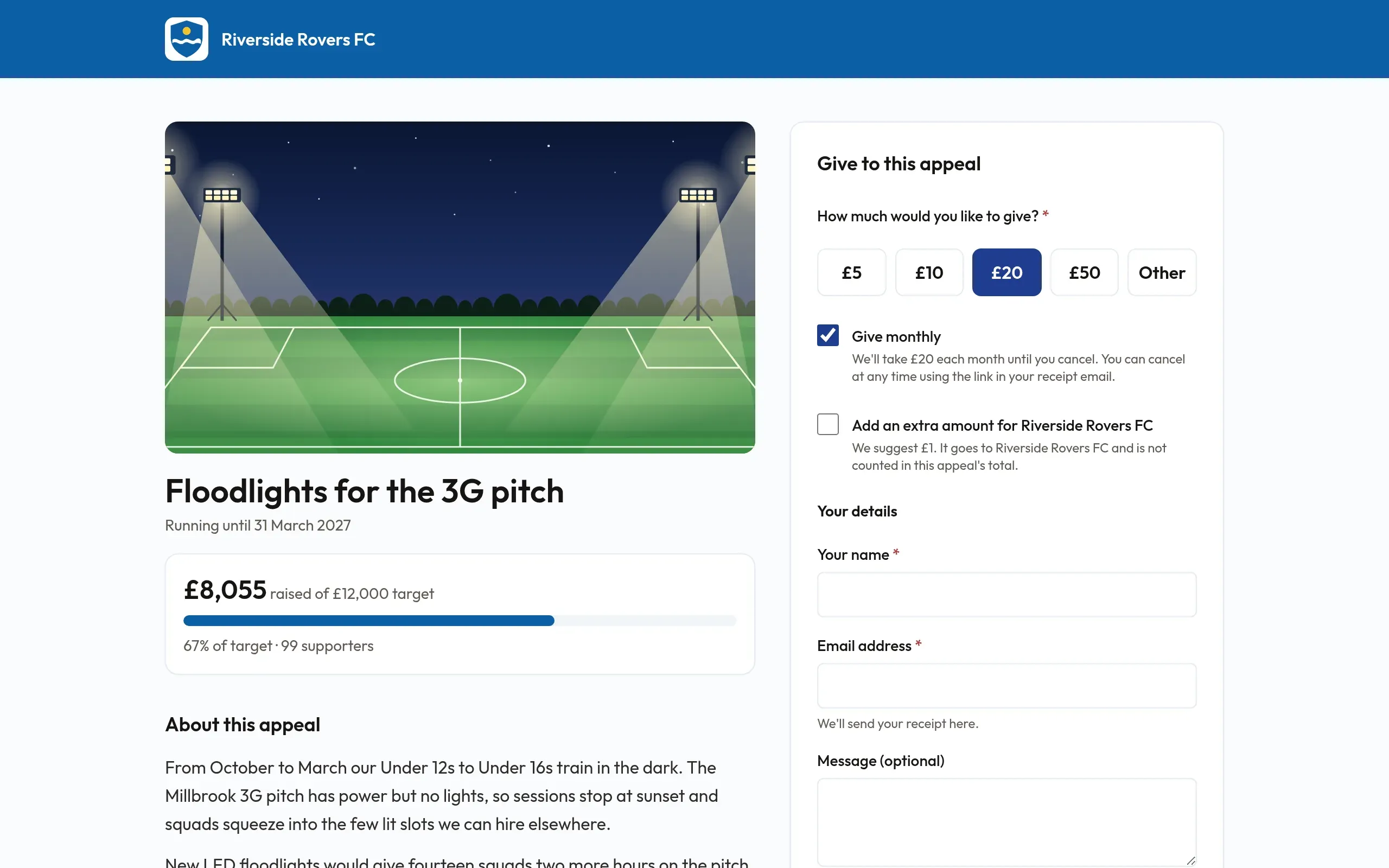
- With the Fundraising power-up, run appeals people can give to once or every month, from a public page you share by link or QR code, with Gift Aid declarations and a ready-made HMRC schedule. It’s in beta and free while in beta: ask us for early access.
See how payments and the Fundraising power-up work, or book a demo and we’ll walk through one of your own fees.